
The Trust Calculus
What’s at Stake When Local Law Enforcement Partners with ICE


The immigration policy environment is shifting fast, and one of the most consequential shifts for immigrant-serving organizations and community leaders is not happening in Congress. It is happening in sheriff’s offices and police departments, where leaders are deciding how closely to align with federal immigration enforcement. Those decisions have direct consequences for the people your organization serves, the relationships you have built, and the local public safety infrastructure your community depends on. They deserve more scrutiny than they are getting.
Why This Matters to Local Leaders
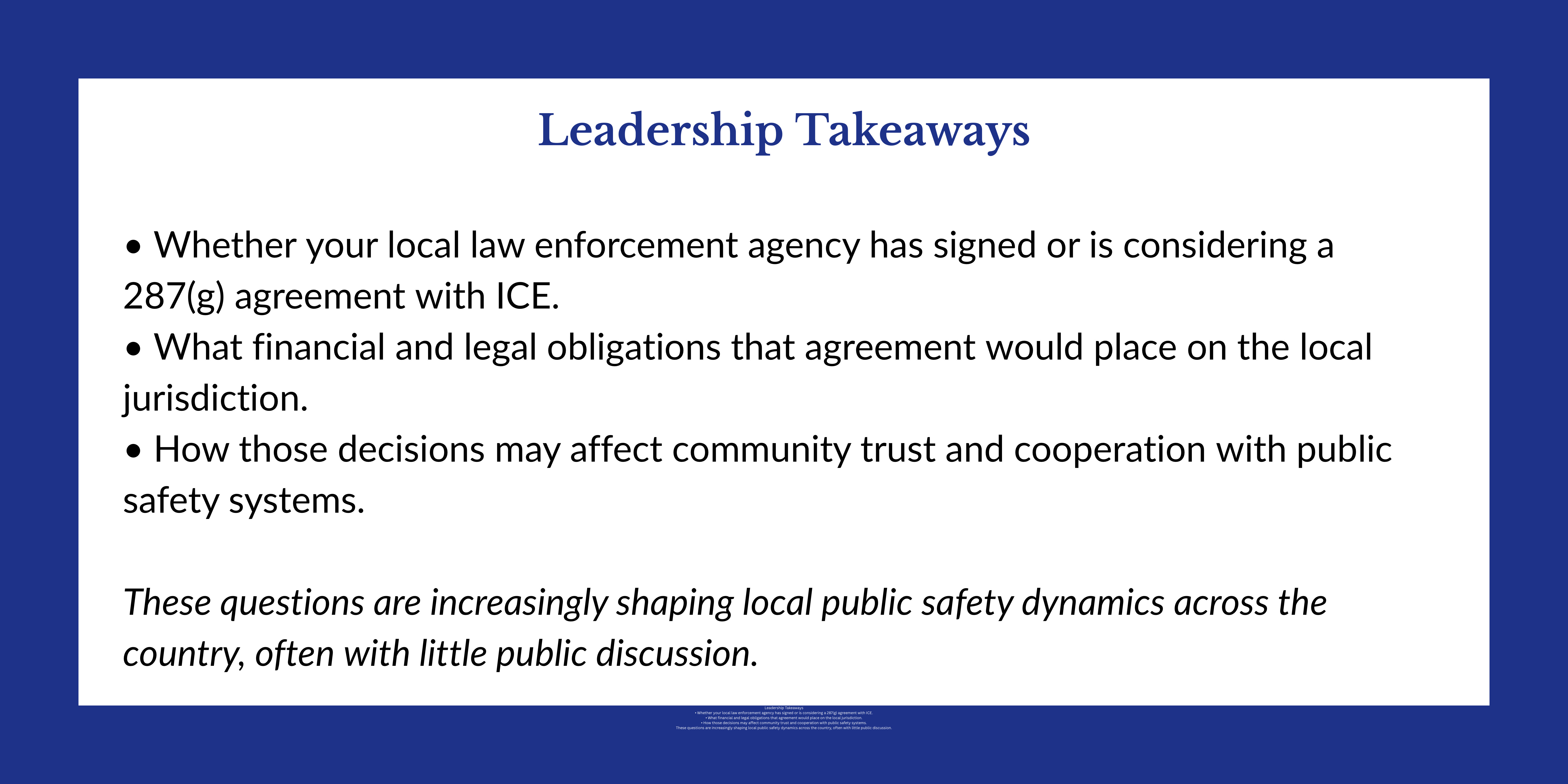
Most immigrant-serving organizations depend, often invisibly, on some functional relationship between their communities and local law enforcement. That does not mean trust is strong or uncomplicated. In many places, organizations like yours are already the bridge, the intermediary, precisely because direct trust is thin. But even that fragile infrastructure serves a purpose. Immigrants who believe that contact with local law enforcement may trigger immigration consequences do not report crimes. Witnesses do not cooperate with investigations. Victims of trafficking and domestic violence do not come forward. U and T visas, which exist specifically to encourage cooperation with law enforcement, become practically inaccessible.
This is not an abstract concern. It plays out in caseloads. It shows up in who does and does not walk through the door. And as communities become more polarized and political violence more visible, the ability of residents to trust that local law enforcement is there to keep them safe, regardless of immigration status, becomes more important, not less. For local elected officials, for executive directors managing frightened staff, for community leaders navigating anxious constituents, understanding where your local law enforcement stands right now is part of the job.
What Minneapolis Teaches Us
Minneapolis Police Chief Brian O’Hara has been unusually candid about what the federal enforcement surge has cost his department, both operationally and institutionally. His force was already understaffed, already in the middle of a fragile rebuilding effort in the years after George Floyd’s murder. When thousands of federal agents flooded the city, the department did not gain a partner. It absorbed chaos. Officers found themselves caught between protesters and federal agents, neither of whom fully understood or trusted what the police were trying to do. The overtime budget for a single month exceeded what the department had planned to spend for the entire year.
O’Hara’s situation is an extreme version of a dynamic that plays out at smaller scale in communities across the country. When a local agency becomes associated, formally or informally, with a federal enforcement apparatus that residents distrust or fear, the local agency absorbs that cost. The trust that took years to build erodes quickly. And unlike federal agencies, local police and sheriffs’ departments cannot simply move on to the next jurisdiction when the operation is over. They stay. Their communities stay.
The Public Safety Framing Is Already Slipping
The standard justification for local-federal enforcement partnerships is public safety: target dangerous people, make communities safer. But the actual pattern of arrests does not match that framing. A significant share of those arrested under the current enforcement surge have no criminal record, or only minor civil violations. For those who do have records, the data available to immigration enforcement often tells an incomplete story. It may show an arrest without showing how the case was resolved, what the mitigating circumstances were, whether language or cultural barriers affected the outcome, or whether someone has since served whatever penalty the state deemed appropriate and rebuilt their life.
Even inside the administration, the framing is under pressure. White House officials recently urged House Republicans in a closed-door session to stop defending mass deportations and redirect their messaging to the removal of violent criminals. That is not a rhetorical tweak. It is an acknowledgment that the broader enforcement pattern is not matching the story being told to justify it. Polling now shows that nearly half of Americans believe the deportation campaign has gone too far, including roughly one in five voters who supported the president in 2024. For local leaders, the lesson is this: the federal posture is already recalibrating in response to public pressure, but local agencies that have signed enforcement agreements in the current climate will own those decisions regardless of where federal policy lands.
What 287(g) Actually Means
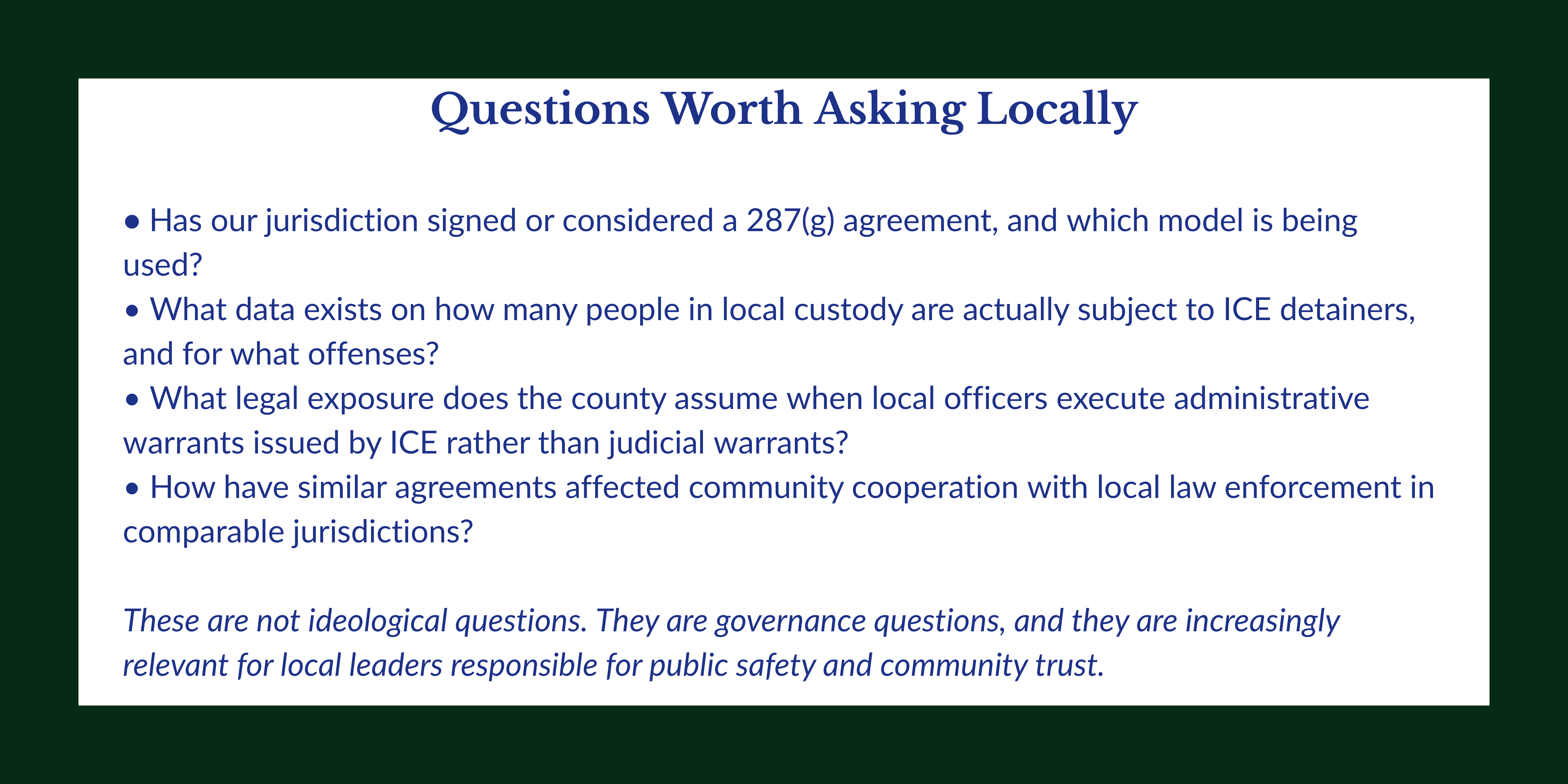
The most visible and formal mechanism for local-federal alignment is the 287(g) agreement, and ICE has expanded its use significantly in recent months. Without turning this into a technical explainer, there are a few things every community leader should understand. Participation is entirely voluntary. Local agencies bear most of the personnel cost, including salaries, benefits, and overtime for anyone seconded to federal functions, while federal reimbursement is partial and discretionary. The warrants that local officers may be asked to execute are administrative warrants, not judicial ones. They are not reviewed by a judge, do not require probable cause of a criminal offense, and courts have found local jurisdictions liable for wrongful detentions carried out on that basis.
The decision to enter one of these agreements is supposed to be grounded in local data: how many people in local custody are subject to ICE detainers, what offenses are involved, and what specific public safety gap this agreement is meant to address. Too often, that analytical work is not done. What gets done instead is a political calculation. That is worth naming plainly, because the fiscal and legal exposure attached to these agreements is real and falls locally.
What Local Leaders Can Do With This
If you lead an immigrant-serving organization, the first step is knowing where your local law enforcement stands, because your clients will ask, and they deserve a real answer. If you are a local elected official or working in close proximity to one, the fiscal and legal exposure questions are your most durable leverage points in these conversations. Political arguments about immigration tend to calcify positions. Questions about county liability, personnel costs, and what happens when an administrative warrant turns out to be wrong are harder to dismiss. Comparing jurisdictions that have signed agreements with those that have not, and tracking what the data actually shows about public safety outcomes, is work worth doing and worth sharing.
For everyone in this audience: if you are communicating with boards, funders, or staff about community safety right now, be honest about where trust can and cannot be placed. That honesty is not alarmism. It is good governance. And it is the foundation for helping the people you serve make informed decisions about when and how to engage with local institutions.
Trust Is Infrastructure
The agencies and organizations that will serve their communities most effectively through this period are the ones that treat trust as something you build, invest in, and spend carefully, not a feeling that appears when conditions improve. A humane and well-functioning public safety system depends on community cooperation. Community cooperation depends on trust. And trust, once broken, is slow to rebuild, as Minneapolis is demonstrating in real time.
Understanding what is driving law enforcement decisions in your community, and whether those decisions are grounded in genuine public safety goals or in political alignment, is not a distraction from your work. It is part of it.
Learn More
• Axios: White House tells House Republicans to stop talking about mass deportations (March 2026)
• Politico/Morning Consult poll on public opinion on the deportation campaign (January 2026)
• Wall Street Journal: ICE prosecution of U.S. citizens for interference with law enforcement (March 2026)
• Governing: Minneapolis Chief on Policing a City in Chaos (February 2026)
• Washington Post: Minneapolis police chief fears controversial ICE surge will undermine reforms (February 2026)
• Albany Law School: Overview of 287(g) agreements
• The Other 54 Strategies: 287(g) Agreements - What Law Enforcement Leaders Should Know and Ask Before Signing
Not clear to me your stand on 287(g). If properly implemented, there would be no need for "sanctuary cities" and ICE would more efficiently detain criminals who endanger the immigrant community. Seems to me that was the problem with Minnesota.
Immigration bar should be pushing for a broad legalization -- if only for work authorizations -- to benefit immigrants in country for decade or longer who have clean records and substantial equities including US Citizen children.
Such a measure would have bipartisan support, and would have help solve labor shortages in agriculture, construction, health care and the restaurant industry.